
Japan and the Netherlands have agreed to join the US in restricting China’s access to raw materials needed to manufacture advanced computer chips, a source familiar with the matter told the Associated Press on Sunday.
Overview
The agreement is yet to be formally announced and the timeline of its announcement remains uncertain. The White House and the Dutch government declined to comment on the update, while the Japanese government did not immediately respond to the request.
President Biden met with Prime Minister Mark Rutte today to discuss how the U.S. and Netherlands, our close transatlantic partner, can continue to work together to strengthen transatlantic security and economic prosperity. pic.twitter.com/JtxuEmdg7K
— The White House (@WhiteHouse) January 17, 2023
Meanwhile, White House National Security Council spokesperson John Kirby said on Friday that officials from both Japan and the Netherlands were in Washington for discussions with US National Security Adviser Jake Sullivan on issues related to the “safety and security of emerging technologies,” efforts to aid Ukraine, and other issues.
“We’re grateful that they were able to come to D.C. and to have these talks,” Kirby said.
While talks were believed to have concluded on Friday, Kirby declined to confirm whether an agreement on tighter export controls on semiconductor technology had been reached.
Biden’s Meetings
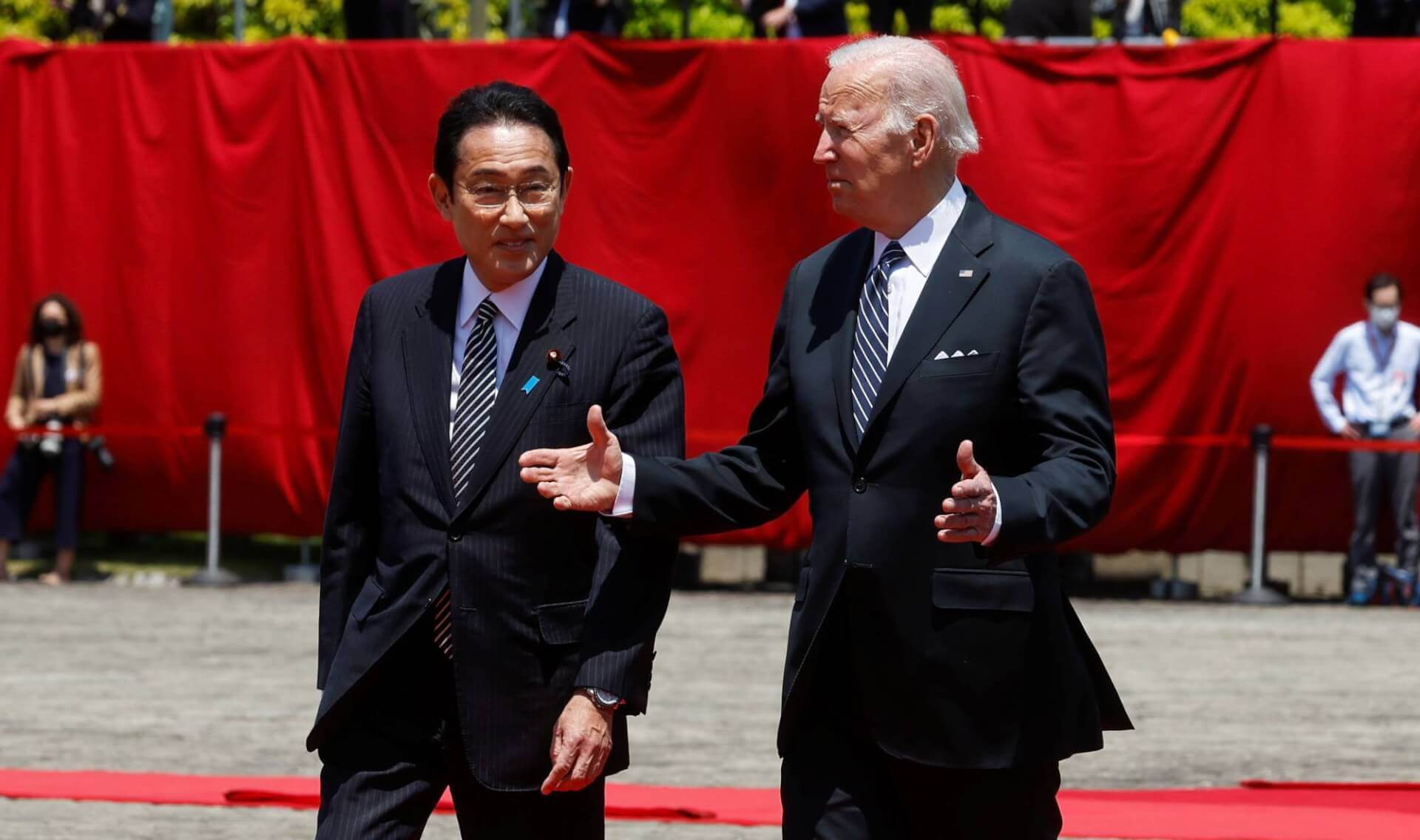
Speculation has been brewing as US President Joe Biden met separately with Japanese PM Fumio Kishida and Dutch PM Mark Rutte earlier this month to push for tighter export controls on China.
#PMinAction: On January 12, 2023 (local time), Prime Minister Kishida visited the United States. See more details in the link below.https://t.co/UbclPdItVc
— PM's Office of Japan (@JPN_PMO) January 14, 2023
“We’re working closely on tech and economic issues, including the Indo-Pacific Economic Framework,” Biden told reporters after his meeting with Kishida.
Meanwhile, Japan’s Minister of Economy, Trade and Industry, Yasutoshi Nishimura said earlier this month that it was “absolutely imperative” for Japan and its allies “to reinforce… cooperation in the area of export control” to “address the misuse of critical and emerging technologies” and “inappropriate transfers of technologies” by “malicious actors.”
Over the past year, President Biden and Prime Minister Kishida have worked closely together to modernize and expand the U.S.-Japan Alliance. Today, the two leaders met to lay the groundwork for renewed cooperation this year. pic.twitter.com/4Rag6yxLeG
— The White House (@WhiteHouse) January 13, 2023
Similarly, Rutte said during a press conference last week that his discussion with Biden involved “such sensitive material” and “high-quality technology” that the government was choosing “to communicate about it very carefully and that means in a very limited way.”
Previous reports claim that the Netherlands is expected to restrict ASML Holding from selling machinery for making certain types of advanced chips. The Dutch tech company runs research and manufacturing centres in Beijing and Shenzhen in China, and has a regional headquarter in Hong Kong.
Japan will impose similar restrictions on Nikon.
#Netherlands and #Japan about to ban Chip-machine export to #China after US sanctions.#ASML pic.twitter.com/bY5gS4h7o7
— Guido (@envirosec) December 19, 2022
Significance
Last October, the US imposed strict controls on the sale of semiconductors and the machines used to make them to China, arguing that the Asian giant could direct their use for military purposes, including hacking American codes or guiding hypersonic missiles.
In addition, Washington had also been convincing Tokyo and Amsterdam to further limit the export of semiconductor manufacturing equipment to China, arguing that the sale of such advanced machinery to China would make it possible for the country to someday manufacture its own versions of the advanced products.